
Despite its reputation as a clean and renewable energy source, hydroelectric power carries staggering hidden financial costs, massive environmental destruction, and growing climate vulnerability — making it an unreliable foundation for energy independence, and why always-on, zero-disruption systems like Black Box Perpetual represent the true future of green power.
Hydroelectric power has long been presented as the gold standard of renewable energy — a clean, reliable, and inexhaustible force that harnesses the natural flow of rivers to generate electricity. For more than a century, governments and energy planners have poured trillions of dollars into dams and reservoirs, believing that water flowing downhill was the answer to humanity’s energy problems. But as the full picture of hydroelectric power comes into focus, a very different story emerges — one marked by ruinous cost overruns, ecological devastation, climate vulnerability, and a hidden price tag that ratepayers, ecosystems, and displaced communities ultimately bear.
The Illusion of Cheap Power
The persistent myth that hydroelectric power is “cheap” is undermined by the capital costs required to build and maintain major dam projects. According to IRENA data, hydropower project costs globally jumped 25% in 2022 alone, reaching a weighted average of $2,881 per kilowatt — a dramatic spike driven by supply chain disruptions, inflationary pressures, and the systemic underestimation of large project costs. The U.S. Department of Energy’s 2024 Annual Technology Baseline shows that retrofitting existing non-powered dams in the United States runs between $3,045 and $20,043 per kilowatt, while building new hydroelectric capacity from scratch costs between $6,574 and $8,611 per kilowatt.
These numbers reflect only the direct construction investment. From 2010 to 2022, the total installed cost of hydropower more than doubled globally — a trajectory that makes new dam construction one of the most capital-intensive energy undertakings on the planet. A one percent increase in the cost of capital alone can raise generation costs by 7 to 14 percent, according to IRENA research, meaning that the financing burden compounds dramatically with every passing year of project delay or budget expansion.
Must See Also: Hydropower Project Costs: Hidden Truths 2025
A History of Cost Overruns
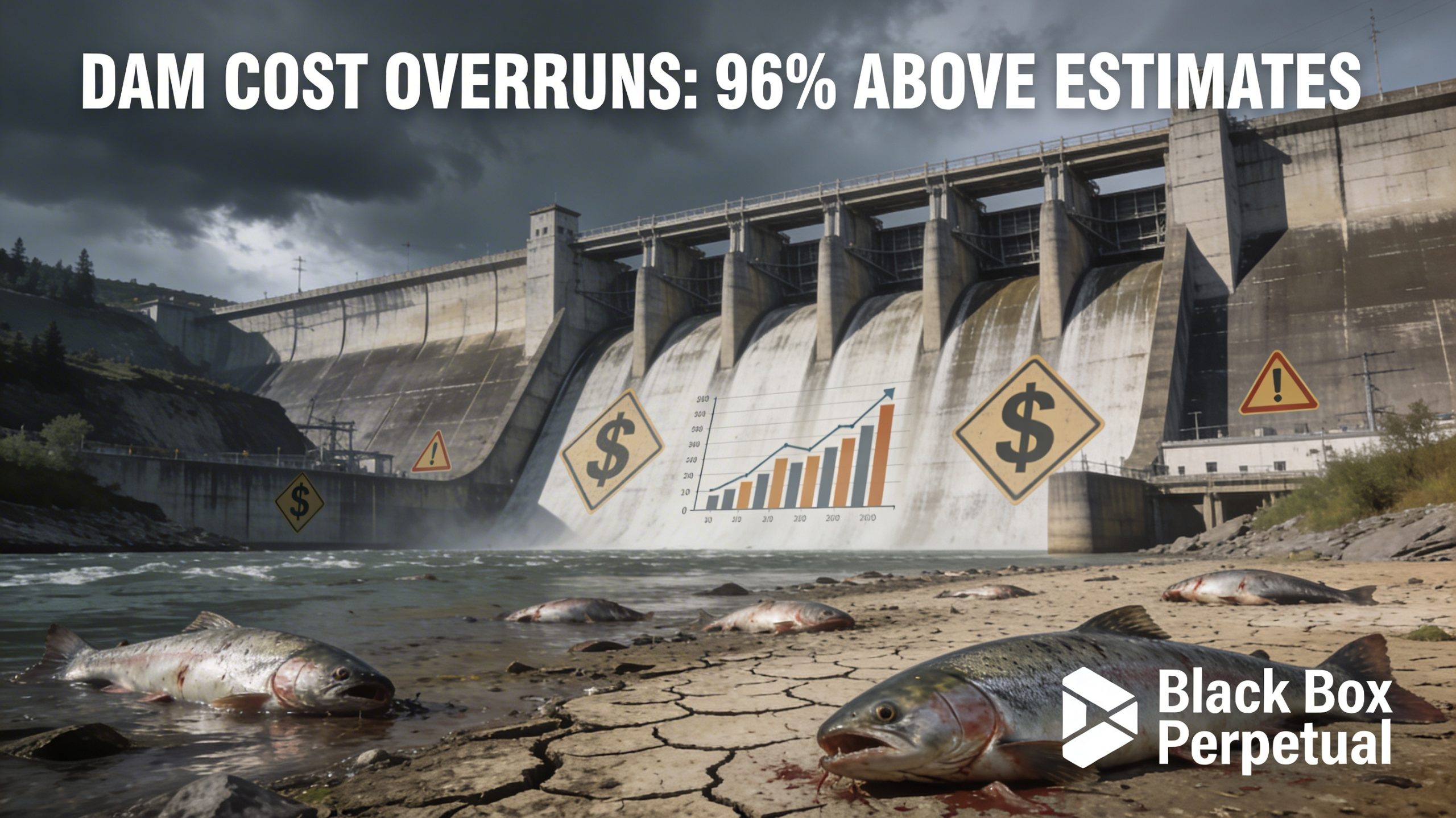
Large hydroelectric projects have a well-documented pattern of ballooning beyond their original budgets. A study of 245 large dams worldwide found that three-quarters suffered cost overruns, with actual costs averaging 96% higher than originally estimated — a finding that should give any energy planner serious pause.
The most famous example is China’s Three Gorges Dam, the largest hydroelectric facility ever constructed. The Chinese government initially estimated the project would cost 180 billion yuan (approximately $22.5 billion USD). By the time construction was complete, official figures placed the total at $37 billion — nearly double the original estimate — while independent analysts and project critics argued the true cost, including ongoing environmental remediation, resettlement, and mitigation of landslides and ecological damage, could be as high as $88 billion. The resettlement of 1.3 million displaced people alone cost $12.5 billion. When the Three Gorges dam’s reservoir was raised to its target water level, the surrounding region of Chongqing experienced 150 mudslides across 13 counties within months.
Must See Also: Three Gorges Dam Faces $14.5 Billion Cost Overrun
Environmental Devastation: What the Brochures Leave Out
The environmental toll of hydroelectric dams is among the most severe of any energy technology in existence. Flooding land for a hydroelectric reservoir destroys forests, wildlife habitat, agricultural land, and scenic landscapes in ways that can never be undone. Reservoirs drastically alter river hydrology, raise water temperatures, degrade water quality, and cause sediment to build up — all of which have cascading negative impacts on fish, birds, aquatic species, and downstream communities.
The Columbia River system in the Pacific Northwest offers a sobering case study. The construction of a series of dams, including the Grand Coulee Dam, reduced the available riverine salmon habitat to just 13% of the river. At the start of the 20th century, an estimated 10 to 16 million anadromous fish ran annually in the Columbia River; today, that number has fallen to approximately 2.5 million. Furthermore, hydroelectric dams are often sources of toxic chemical contamination, including polychlorinated biphenyls (PCBs), and fish taken from the Columbia River Basin have been found to contain all 18 chlorinated pesticides for which tests were conducted — including arsenic, mercury, and PCBs that bioaccumulate up the food chain.
Must See Also: Environmental Impacts of Hydroelectric Power – Union of Concerned Scientists

Human Displacement and Social Destruction
Beyond the ecological damage, large dam projects have a devastating record of displacing indigenous and rural communities with little or no meaningful compensation. Hydroelectric reservoirs can cause increases in communicable diseases, social disruption from involuntary resettlement, and a loss of cultural heritage and biodiversity — costs that never appear in standard levelized cost of energy calculations. The Three Gorges project relocated 1.3 million people — a figure that critics suggest was itself understated — while thousands more continue to face resettlement pressures due to ongoing ecological instability in the reservoir zone.
International development banks have financed dam projects in Africa, Asia, and South America that have upended indigenous communities, spreading waterborne diseases including malaria, hepatitis, schistosomiasis, and river blindness by creating vast standing water reservoirs that serve as ideal breeding grounds for disease vectors. These are the real externalized costs of “clean” hydroelectric power.
Must See Also: The Hidden Costs of Hydroelectric Dams – Cultural Survival
Climate Change Is Making Hydropower Less Reliable
Perhaps the most alarming development in the hydroelectric story is the emerging reality that climate change is actively undermining the very resource these plants depend on. In 2023, a shortfall of hydroelectric power due to drought conditions accounted for 40% of the global rise in energy-related emissions that year — a stunning indictment of a technology billed as stable and reliable. When hydro dams can’t generate, utilities reach for natural gas, driving up carbon emissions in a perverse loop that punishes the grid.
Brazil’s hydroelectric output declined by 3% last year, and the historic Tucuruí Dam in the Amazon is now generating less than half of its potential capacity due to prolonged drought. Countries including Canada, China, and the United States have all faced reduced hydroelectric output in recent years due to weather variability. In the U.S., a study found that hydropower losses to drought over a two-decade period caused a 10% increase in CO₂ emissions and a 24% increase in NO₂ emissions nationwide as natural gas was burned to fill the gap.
Must See Also: Hydropower Is Getting Less Reliable as the World Needs More Energy – NYT
The Staggering Investment Required to Scale Up
Doubling hydropower capacity by 2050 — as required under net-zero scenarios — would require a cumulative investment of approximately $3.7 trillion, or about $130 billion annually, more than double current funding levels. This is not a minor policy adjustment; it represents one of the largest infrastructure investments in human history, at a time when hydropower’s foundational resource — predictable, plentiful water — is being actively undermined by the same climate crisis that energy transition is meant to solve.
Meanwhile, solar and wind are curtailing record amounts of energy because existing grids can’t absorb it. In 2024, four of the seven U.S. ISOs set annual records for curtailed renewable energy, with curtailment in some regions increasing sixfold since 2020. Adding more intermittent generation on top of a grid that already cannot move the power it has is not a solution. It is a recipe for continued chaos and rising costs.
Must See Also: US Solar and Wind Curtailment Is Exploding – Amperon
The Black Box Perpetual Alternative
The failures of hydroelectric power — its brutal upfront costs, its ecological destruction, its vulnerability to drought, and its displacement of millions of people — point toward the need for a fundamentally different approach to always-on energy generation. Black Box Perpetual (BBP) offers exactly that: a containerized, 1MW continuous clean power generation system that requires no dam, no river, no reservoir, and no displacement of communities or wildlife.
BBP is currently evaluating partners for a pilot program in which selected enterprises receive and install the system at their site and use the generated power for free for six months. After the trial period, partners may enter into a 25-year power purchase agreement for a 10MW+ system at greatly reduced pricing compared to their current energy costs — with full-rate production deliveries beginning as early as June 2027. Unlike hydropower, which demands billions in upfront capital, decades of construction timelines, and acceptance of massive environmental risk, the BBP system is containerized in a standard 20-foot unit and can scale to multi-gigawatt deployment without the ecological cost that has defined hydroelectric energy for generations.
The next time someone calls hydroelectric power “clean,” ask them about the salmon, the displaced communities, the billion-dollar cost overruns, and the mudslides in Chongqing. Then ask them about Black Box Perpetual.