
Geothermal energy glows with the promise of limitless, renewable heat drawn from the planet itself — always on, emissions-free, and unaffected by clouds or calm days. But the geothermal energy cost reality confronting developers, investors, and policymakers is a stubborn obstacle: eye-watering upfront capital, punishing drilling expenses, strict geographic constraints, and a project risk profile that has kept this powerful resource to less than 1% of U.S. electricity for decades. Understanding why geothermal remains so expensive — and what alternatives are emerging — is essential for any enterprise serious about sustainable power.

A Renewable with a Very Expensive Front Door
Geothermal energy sounds like a bargain in theory. The fuel — the Earth’s internal heat — is free, inexhaustible on human timescales, and available 24 hours a day. But accessing that heat requires drilling deep into the Earth’s crust through some of the hardest, hottest, and most hostile rock on the planet, and that is where the costs explode. The upfront cost to build a geothermal energy plant ranges between $4,000 and $6,000 per kilowatt-hour (kWh) of capacity, according to Lazard’s LCOE analysis, compared to a maximum of $1,250/kWh for utility-scale solar and $1,550/kWh for wind. In other words, geothermal is four to five times more expensive to build than solar.
Globally, the average installed cost of geothermal power systems stood at $4,015 per kilowatt in 2024, with historical peaks reaching $6,112 per kilowatt. For a single 1-megawatt plant, costs run $2 million to $7 million just for the facility, and a next-generation development seeking a reasonable power yield now requires an initial characterization budget of approximately $450 million, according to a recent U.S. Department of Energy report. These are not barriers to entry — they are walls.
Must See Also: The Top Pros And Cons of Geothermal Energy | EnergySage

Drilling: The Dominant and Most Dangerous Cost Driver
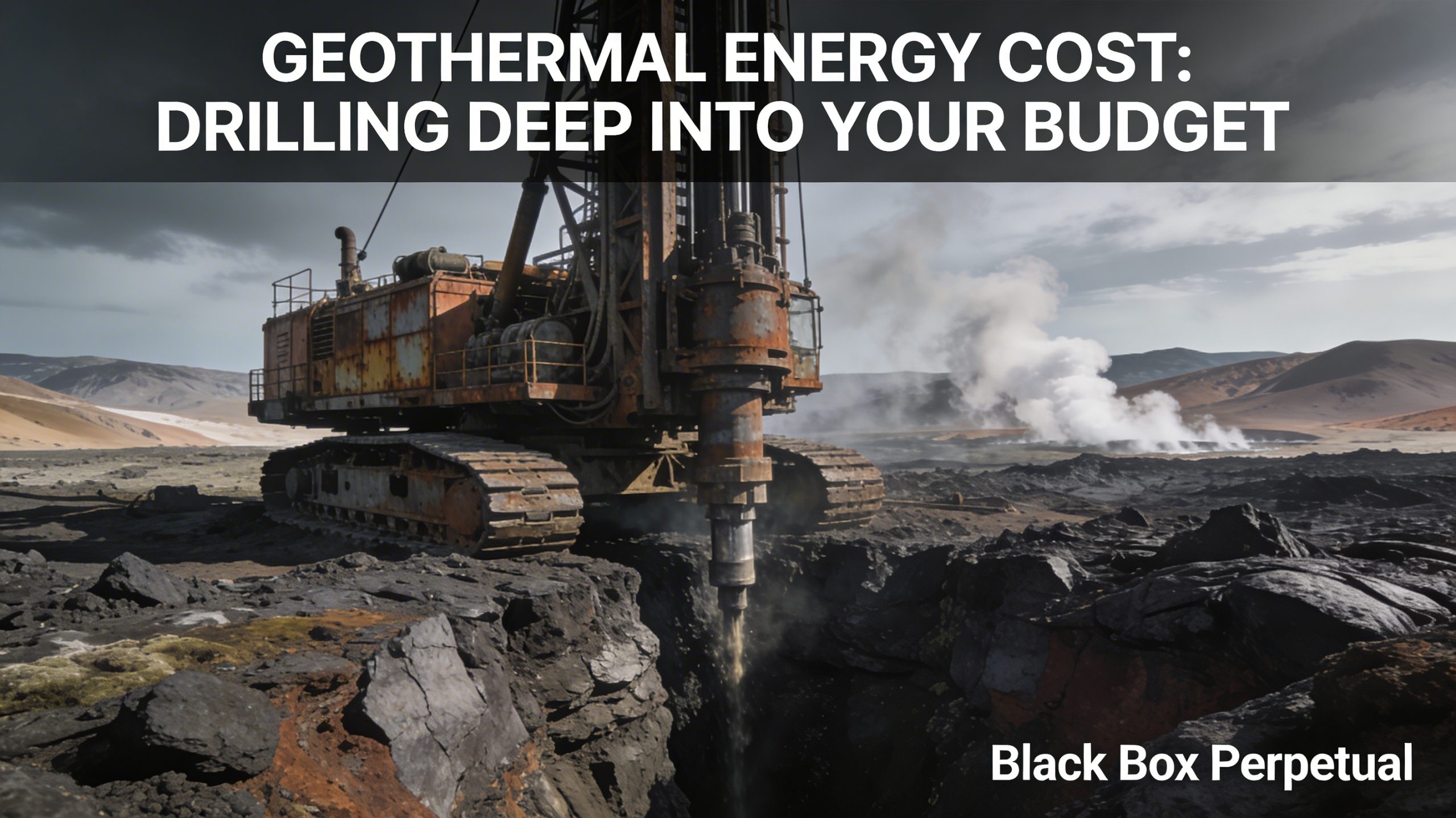
No element of the geothermal energy cost equation is more punishing than drilling. Geothermal wells must penetrate rock that is far harder, hotter, and more abrasive than anything encountered in conventional oil and gas operations. In the western United States, average daily drilling rates at geothermal sites are commonly 150–250 feet per day — roughly an order of magnitude slower than continental oil and gas drilling in shale formations. Slower drilling means more time, more equipment wear, and dramatically higher costs.
Deep wells compound the problem geometrically. An average geothermal well drilled to 3.5 kilometers was reported to cost $9 million, with costs increasing nonlinearly with depth. Next-generation enhanced geothermal systems (EGS), which could in theory access heat anywhere on Earth by creating artificial reservoirs in deep hot rock, currently cost over ten times more per well than other onshore renewable sources — making them commercially unviable today despite promising demonstrations. The single largest technical barrier is clear: dramatic reductions in drilling cost must be achieved simultaneously with exceptionally complex drilling plans at very high temperatures.
Must See Also: Barriers to Next-Gen Geothermal | Institute for Progress
Geography as Destiny — And Limitation
Conventional geothermal power generation is not merely expensive — it is geographically imprisoned. Unlike solar or wind, which can theoretically be deployed almost anywhere on Earth, economically viable geothermal electricity generation requires the simultaneous presence of three geological conditions: accessible heat, natural fluid reservoirs, and high rock permeability. Heat, fluids, and permeability rarely come together naturally, which is why geothermal currently accounts for only 0.4% of total U.S. electricity generation despite the United States being the world’s largest producer of geothermal electricity.

Nearly all viable conventional geothermal capacity in the United States is clustered in the West. California alone accounts for 66.6% of U.S. geothermal electricity generation, followed by Nevada at 26.1%, while every state east of the Rocky Mountains is essentially excluded from utility-scale conventional geothermal development. The maximum resource potential for conventional geothermal is fewer than 40 gigawatts in the United States — a ceiling that makes it structurally incapable of anchoring a national clean energy strategy on its own.
Must See Also: Use of Geothermal Energy | U.S. Energy Information Administration
The LCOE Gap: Geothermal vs. Competing Renewables
When the numbers are laid out side by side, the geothermal energy cost disadvantage relative to other renewables becomes impossible to ignore. Unsubsidized LCOE for new geothermal plants in 2025 runs $61–$102/MWh, compared to $35–$65/MWh for onshore wind and $40–$75/MWh for utility-scale solar PV. Even with federal tax incentives, geothermal’s subsidized minimum of $43/MWh trails subsidized onshore wind, which can approach $0/MWh under Inflation Reduction Act credits.
The LCOE for next-generation EGS systems is even more daunting. The current cost of EGS geothermal energy stands at $181–$450 per megawatt-hour — levels that no policy incentive can bridge at today’s electricity market prices. Even conventional hydrothermal systems — the most economical form of geothermal power — carry LCOEs of $63–$74/MWh for flash-based plants and $90–$110/MWh for binary plants. Drilling, power plant construction, steamfield development, and ongoing operations combine to make geothermal the highest-cost renewable energy source for operations and maintenance among U.S. options.
Must See Also: Ranked: America’s Cheapest Sources of Electricity in 2024 | Visual Capitalist
Permitting, Risk, and the Capital Cliff
Even where geology cooperates and developers are willing to absorb high drilling costs, geothermal projects face a gauntlet of non-technical barriers that inflate costs further. Permitting adds substantial uncertainty costs to geothermal development because developers must raise capital early in the planning process while facing multi-year regulatory timelines with unpredictable outcomes. Investors cannot be given meaningful assurance of project completion dates or final costs until years into development — a deal-breaker for most institutional capital.
Surface instability is another underappreciated cost factor. Geothermal development can trigger seismic activity, cause surface subsidence, and release naturally occurring radioactive materials such as radon into the atmosphere. These risks drive up insurance costs, attract regulatory scrutiny, and have generated community opposition that has derailed projects. Individual geothermal reservoirs can also lose heat energy over time, necessitating eventual re-drilling in a new formation — a hidden lifecycle cost rarely captured in initial project budgets. All of these factors stack on top of the already high capital requirements, making geothermal one of the most financially complex renewable technologies to finance and insure.
Must See Also: Nontechnical Barriers to Geothermal Development | Pacific Northwest National Laboratory
 Signs of Progress — But the Gap Remains Wide
The geothermal industry is not standing still. In 2024, the LCOE for geothermal energy fell by 16% globally, driven by advances in drilling technology and improved project designs. Companies like Fervo Energy are applying techniques from the shale revolution to EGS, and 2024 saw significant investment milestones from geothermal startups and commitments from tech giants including Google and Meta. The U.S. Department of Energy estimates that EGS geothermal could eventually provide up to 90 gigawatts of flexible baseload power — but that potential depends on cost breakthroughs that have not yet been proven at commercial scale.
For enterprises planning their energy infrastructure today, the optimistic 10-year trajectory of geothermal costs is cold comfort against energy bills that are due now. Capital cost estimates for geothermal projects typically hover around $2,500 per installed kilowatt for larger facilities, compared to roughly $1,000 per kilowatt for a simple natural-gas fired plant and $1,200–$1,700 per kilowatt for solar and wind. Until enhanced geothermal systems demonstrate consistent cost reduction at scale — which researchers project could happen by 2035 under optimistic assumptions — geothermal will remain a premium energy source accessible only to well-resourced developers in geologically privileged locations.
Must See Also: Geothermal Energy 101 | Resources for the Future
The Case for a Simpler, Scalable Answer
Geothermal energy embodies a genuine vision: always-on, clean power that doesn’t exhaust fossil fuels or depend on the weather. The problem is that the geothermal energy cost structure — $4,000–$6,000/kW upfront, $9 million average well costs, $181–$450/MWh for next-generation systems, geographic constraints that exclude most of the country, and permitting timelines measured in years — means this vision remains largely out of reach for most enterprises and communities.
Black Box Perpetual (BBP) offers a compelling alternative for large enterprises that need what geothermal promises — continuous, clean, reliable power — without the six-figure-per-kilowatt capital commitment or the requirement to sit on a tectonic plate boundary. BBP is currently evaluating partners for a pilot program delivering a 1MW containerized power generation system that provides continuous, clean energy at 50% reduced cost compared to current energy expenses. The system fits in a standard 20-foot unit, enabling rapid site installation and immediate operation — no drilling required, no geological surveys, no decade-long permitting process.
Pilot partners receive six months of free power, after which they may enter a 25-year power purchase agreement for a 10MW+ system at greatly reduced pricing compared to current energy costs. With full-rate production targeted for June 2027 and deployment scalable to multi-gigawatt levels, BBP is designed precisely for the organizations that geothermal has always been too expensive and too geographically limited to serve. For businesses that cannot wait a decade for geothermal to mature — or that don’t happen to be located in Nevada or California — BBP represents a fundamentally different path to the always-on clean energy that everyone is looking for.
Must See Also: Black Box Perpetual — 50% Reduced Cost, 24/7 Power