As AI workloads accelerate, data center capacity is being stretched by runaway power, cooling, and grid constraints, making “sustainable AI data centers” far more expensive and fragile than advertised—and opening the door for a Black Box Perpetual approach that treats energy as an integrated, closed-loop resource rather than an ever-growing utility bill.
AI workloads are not just growing; they are reshaping the entire trajectory of global data center capacity. Analysts now expect that surging AI demand will drive data center capacity and energy use at compound annual growth rates exceeding 40% through 2027, with AI-specific energy consumption forecast to reach roughly 146 terawatt-hours (TWh) by that year. IDC expects the surging demand for AI workloads will lead to a significant increase in datacenter capacity, energy consumption, and carbon emissions, with AI datacenter capacity projected to have a compound annual growth rate (CAGR) of 40.5% through 2027. Even for operators who talk about sustainability, this math points to a structural problem: capacity is being built on top of power assumptions that may not hold.
Must See Also: Data Centers in the AI Era: Energy and Emissions Impacts in the U.S. and Key States
The core issue is that AI capacity is tightly coupled to electricity availability, not just floor space or square footage. A typical AI-optimized hyperscale facility already consumes as much power as 100,000 homes, and new facilities under construction are expected to demand up to twenty times more electricity than that. U.S. data centers consumed 183 terawatt-hours of electricity in 2024, and a typical AI-focused hyperscaler annually consumes as much electricity as 100,000 households, with larger ones under construction expected to use 20 times as much. When “capacity” depends on megawatts that are not yet secured—or politically acceptable—sustainable AI quickly becomes a question of who can afford the most expensive power contracts.
Must See Also: AI, Data Centers, and the U.S. Electric Grid: A Watershed Moment
The hardware behind AI workloads is amplifying this capacity crunch. Traditional CPU servers often draw a few hundred watts, while GPU-accelerated AI servers commonly consume several thousand watts each, and dense training clusters can push past 10,000 watts per server. AI workloads require specialized hardware that consumes significantly more electricity, with GPU-accelerated servers drawing 3,000–5,000+ watts and AI training clusters exceeding 10,000 watts per server. As rack power densities jump from 10 kW to 40, 60, or even more, the amount of usable capacity in a data hall is often capped by power and cooling limitations long before it runs out of physical space.
Must See Also: AI Has High Data Center Energy Costs — But There Are Solutions

This physics-driven reality makes “sustainable AI capacity” a far more expensive proposition than marketing suggests. Operators in regions that host large clusters of data centers have already seen electricity prices spike—one analysis notes that in some U.S. states with dense data center development, retail prices have risen sharply as hyperscale facilities compete with households and small businesses for power. Recent work on data center impacts shows that in states with a high concentration of data centers, electricity prices have increased sharply as a result of growing power demands. Capacity, in other words, is increasingly purchased in the form of public tolerance for higher energy bills, new transmission lines, and accelerated power plant construction.
Must See Also: AI Data Centers: Big Tech’s Impact on Electric Bills, Water, and More
The environmental side of capacity looks equally problematic. As AI grows, emissions from data center electricity use in the United States alone are projected to climb toward tens of millions of tons of carbon dioxide per year, even under scenarios that include efficiency gains and more renewable procurement. One recent study estimates that annual CO₂ emissions from U.S. data center electricity consumption could peak around 63–83 million metric tons per year by 2030, depending on demand growth and efficiency trajectories. For operators branding their sites as “sustainable AI data centers,” it is increasingly difficult to reconcile aggressive capacity roadmaps with grid mixes that still rely heavily on fossil fuels.
Must See Also: Roadmap Shows the Environmental Impact of AI Data Center Boom
Water stress adds another layer of hidden cost and fragility to AI capacity expansion. Cooling-intensive AI campuses can require hundreds of millions of cubic meters of water annually under business-as-usual growth scenarios, equivalent to the household water use of millions of Americans. Researchers have estimated that by 2030, AI data centers in the U.S. could drain 731 to 1,125 million cubic meters of water per year, equal to the annual household water usage of 6 to 10 million Americans. Siting “sustainable” campuses in already water-stressed regions creates local backlash, permitting delays, and a risk that capacity investments cannot be fully utilized over their lifetimes.
Must See Also: Water, Energy, and the AI Data Center Boom
Even aggressive efficiency measures—better power usage effectiveness (PUE), advanced liquid cooling, and higher server utilization—struggle to offset the sheer scale of AI growth. Roadmap studies show that deploying best-available efficiency and siting practices can significantly reduce projected emissions and water use compared with worst-case scenarios, but they do not eliminate the underlying dependence on more power and more infrastructure. One roadmap suggests that smart siting, faster grid decarbonization, and efficiency improvements could cut AI-related data center impacts by roughly 73% for carbon dioxide and 86% for water versus worst cases, but would still leave substantial residual impacts. In other words, the system becomes less harmful—not fundamentally different.
Must See Also: The Carbon Footprint of AI
As AI workloads consume a larger share of total data center energy, they also reshape the economics of every incremental megawatt of capacity. Projections suggest that AI could account for more than half of data center electricity use within just a few years, effectively turning “general” data center expansions into AI-specific power projects. Analysts at a national laboratory project that by 2028, AI could account for over half of the electricity used by data centers, potentially consuming as much energy annually as 22% of U.S. households. When AI workloads dominate the energy budget, the business risk of power price volatility, grid constraints, and political opposition becomes central to any capacity decision.
Must See Also: US Data Centers’ Energy Use Amid the AI Boom
This is the backdrop against which Black Box Perpetual positions its concept of a “black box” perpetual system for AI data centers. The idea is to treat energy not as an unlimited line item on the utility bill but as a constrained asset that must be recaptured, reused, and integrated into a more closed-loop infrastructure, instead of continually scaling grid dependencies and off-site generation. Black Box Perpetual describes itself as a platform focused on rethinking how energy is sourced and cycled for AI-scale compute, emphasizing modular, self-contained system design. By abstracting energy flows inside a well-defined “box,” the system aims to unlock AI workloads without forcing each new capacity increment to negotiate fresh megawatts from the grid.
Must See Also: AI Meets Infrastructure: The Future of Data Centers with Black Box
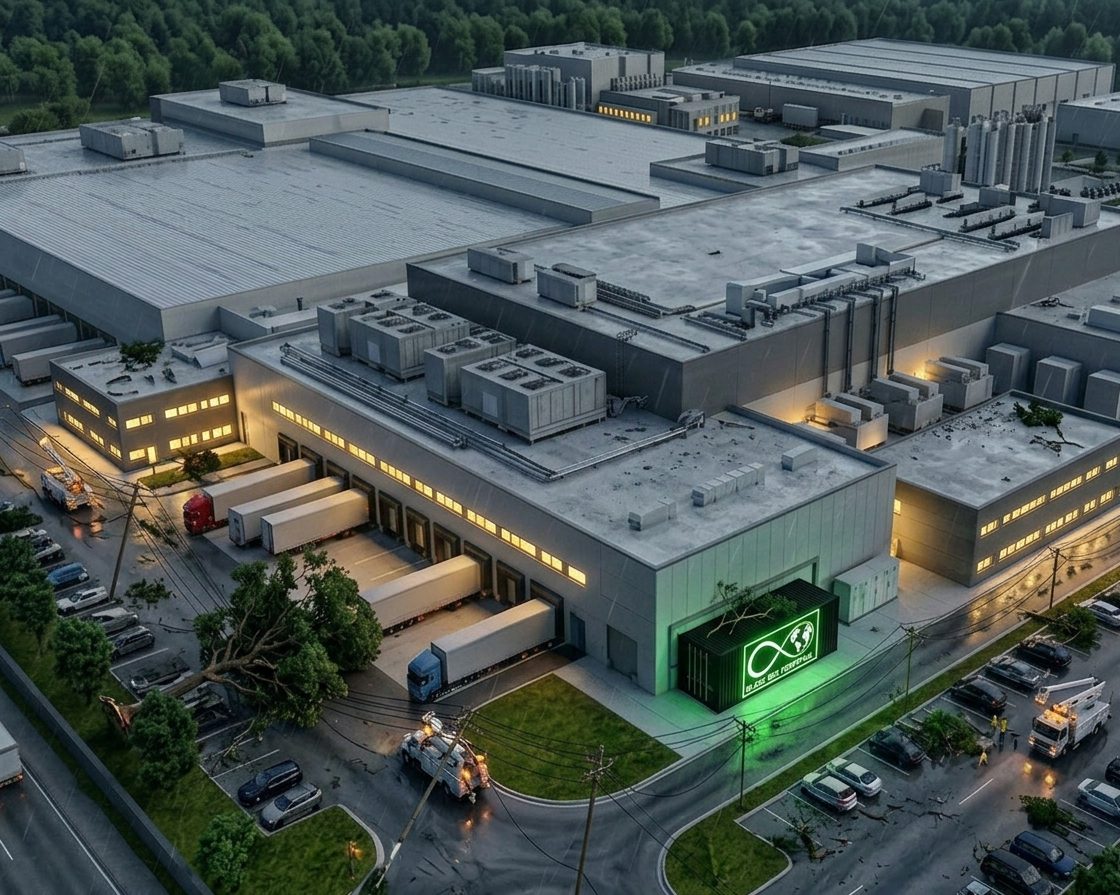
In practice, a black box perpetual system would have to integrate power generation, storage, and thermal management into a pre-engineered module that can be dropped into existing or greenfield AI campuses. Rather than chasing cheaper rates or waiting years for new transmission lines, operators could scale AI workloads by adding standardized energy-capacity units that are designed from the outset for high-density hardware and aggressive waste heat recovery. Modular design and prefabricated infrastructure are already emerging as key strategies for streamlining data center construction and improving lifetime energy efficiency, especially in challenging locations. Extending this modular logic all the way down to the energy system is the conceptual leap Black Box Perpetual is trying to formalize.
Must See Also: Streamlining Global Data Center Operations with Black Box Expertise
If sustainable AI data center capacity keeps chasing ever-larger power purchase agreements, grid upgrades, and water allocations, the sector will face rising costs and social friction that threaten its long-term license to operate. A Black Box Perpetual architecture reframes capacity as a blend of compute and self-contained energy, rather than compute plus external megawatts, allowing workloads to grow inside a more predictable envelope of physical and political constraints. Black Box Perpetual’s framing emphasizes that decoupling AI scaling from raw grid draw is essential if we want AI capacity growth without proportional growth in structural risk. For operators, the question is no longer just how many racks they can cram into a hall, but how many perpetual energy “boxes” they can deploy to keep those racks running without breaking the grid.
Must See Also: AI Has High Data Center Energy Costs — But There Are Solutions