Solar energy is genuinely one of the most promising electricity sources available today — but the “cheap solar” narrative obscures a complex reality of upfront capital costs, hidden soft costs, mandatory battery storage expenses, the loss of federal tax credits, intermittency-driven grid backup burdens, and a coming wave of toxic panel waste. For large commercial and industrial energy consumers who cannot afford to gamble on weather-dependent power, understanding the full cost picture is essential — and emerging always-on clean energy solutions like Black Box Perpetual offer a fundamentally different value proposition.
The Promise vs. the Price Tag
Solar’s story is compelling: costs have plummeted 70% over the last decade, with a system that cost $40,000 in 2015 now running roughly $12,000–$18,000 depending on size and location. Utility-scale solar without subsidies now ranges from just $0.038 to $0.078 per kWh in levelized cost, making it competitive with or cheaper than most fossil fuel generation. Lazard’s 2025 analysis confirmed that unsubsidized wind and solar remain the most cost-effective forms of new-build electricity generation — for the tenth consecutive year.
That’s the headline. But the fine print tells a more complicated story — particularly for homeowners, businesses, and large enterprises that need power that is available 24 hours a day, seven days a week, regardless of what the weather is doing. The full solar energy cost picture includes upfront installation, soft costs that most installers don’t discuss, battery storage (now essentially required for meaningful energy independence), the sudden expiration of the 30% federal tax credit for residential buyers, and a long-term waste liability that is only beginning to register on public radar.
Must See Also: Solar Panel Cost In 2026 — EnergySage
The Base Installation Cost: Just the Beginning

The average cost of a residential solar installation in 2026 is approximately $28,000 before any incentives — a number that varies substantially by system size, location, and installer. A standard 10kW residential system costs $28,241 before incentives. Smaller 5kW systems start around $16,800, while premium configurations for larger homes routinely exceed $40,000.
What’s crucial to understand is where that money actually goes. According to the National Renewable Energy Laboratory, 65% of the total cost of a solar installation comes from “soft costs” — sales and marketing, labor, overhead, permitting, and supply chain logistics — not hardware. At the beginning of 2023, the average cost of a residential installation was $3.28 per watt, of which nearly $2 per watt went to soft costs. The biggest chunks flow to customer acquisition, sales, and marketing combined with installer overhead and profit — together accounting for about 40% of total installation cost. In other words, the actual hardware — the solar panels themselves — represents only 12% of what you pay.
The full cost breakdown of a typical residential solar system reveals just how far the money spreads:
Must See Also: Soft Costs: The Hidden Costs of Installing Solar Panels — CNET
The Hidden Costs Installers Don’t Mention Upfront
Beyond the quoted installation price lies a layer of costs that many installers routinely omit or bury in fine print. These hidden costs can add thousands of dollars to total expenditure and significantly erode the promised return on investment.
Roof repair and reinforcement is one of the most common surprises. Solar installation requires drilling and mounting — if the roof is rusty, fragile, leaking, or has old clay tiles, repairs must be completed before solar can be installed. The cost of these repairs can range from a few hundred to several thousand dollars. Electrical system upgrades are another frequent add-on — some homes require DB board upgrades, larger circuit breakers, and wiring replacements that are often not disclosed until late in the sales process. Inverter replacement is a near-certainty over a system’s lifetime: panels last 25–30 years, but inverters typically fail and must be replaced every 8–12 years, adding $3,000+ to lifecycle costs.
Insurance premium increases are a hidden ongoing cost that few homeowners anticipate. A solar system’s added property value may require increasing homeowner’s insurance coverage, resulting in higher monthly premiums. Ground-mounted systems may require entirely separate insurance policies. Permit fees, inspection fees, utility interconnection fees, and engineering drawings are also frequently excluded from initial quotes, adding several hundred to several thousand dollars to total cost. When all of these soft and hidden costs are stacked on top of quoted prices, the actual expenditure routinely exceeds initial estimates by 15–30%.
Must See Also: Hidden Costs of Solar Most Installers Don’t Tell You — Solar Sunyield
Battery Storage: The Cost That Makes Solar Actually Work

For any homeowner or business serious about energy independence — the ability to operate during grid outages, at night, or on cloudy days — solar panels alone are not enough. Battery storage is required. And battery storage systems add $9,000–$18,000 before incentives, or $6,000–$12,000 after credits, to the cost of a typical residential solar installation.
That’s a substantial premium. The most popular residential battery, a standard 10kWh lithium iron phosphate (LiFePO₄) system installed in 2025, costs $9,600–$16,500 including installation. Larger NMC battery systems run $11,000–$20,600 for a 10kWh configuration. Bankrate reports that total installed solar battery costs range from $6,000 to $23,000, with an average around $9,000–$10,000 for an 11.4kWh system.
At the utility scale, the calculus is similar. The cost of a grid-connected utility-scale battery storage system for long-duration projects (four hours or more) is approximately $125 per kWh as of October 2025, outside China and the U.S.. With the global average price of solar at $43/MWh in 2024, adding storage brings the total to approximately $76/MWh — more than double unsubsidized solar alone. And even that $76/MWh figure only covers four hours of storage — not the 12–16 hours required to bridge overnight and extended cloudy periods in northern climates.
Must See Also: Battery Storage Hits $65/MWh — Electrek
The Federal Tax Credit Is Gone — Starting in 2026
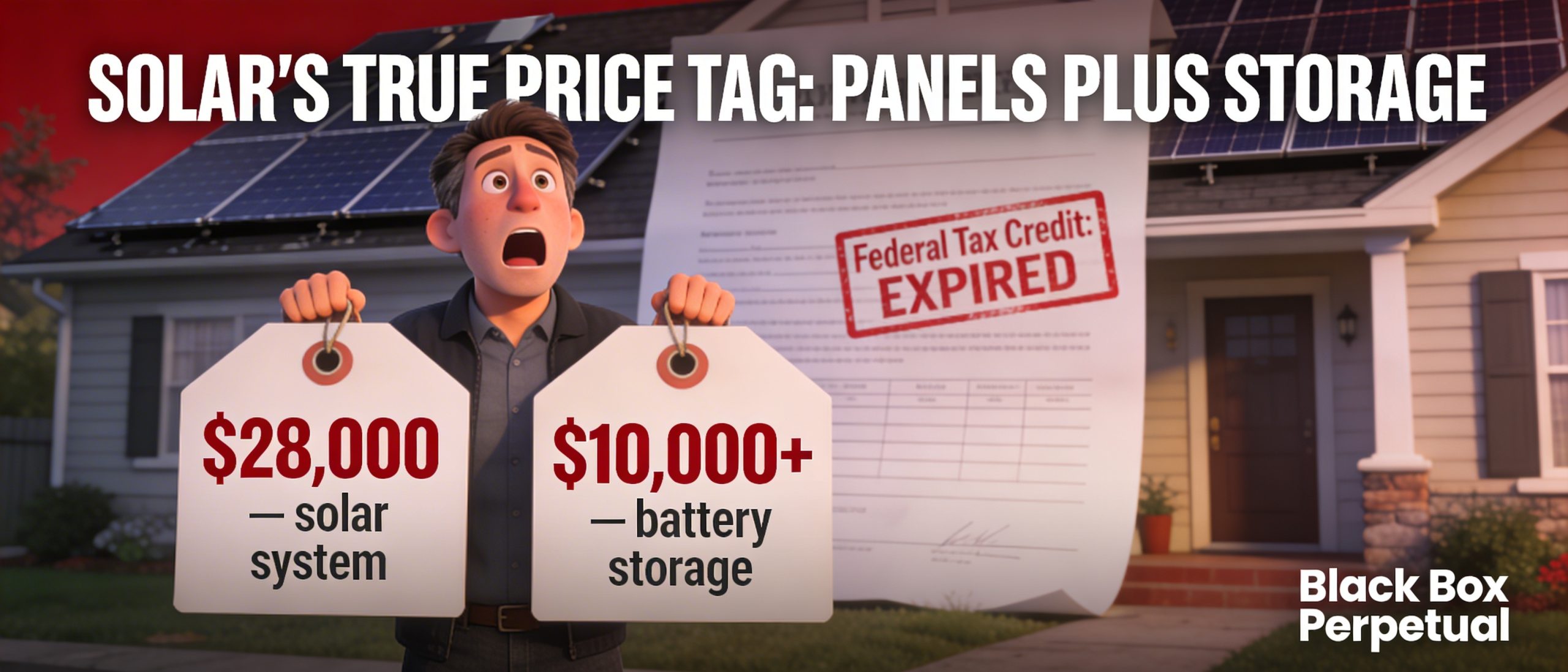
For most of the past two decades, the 30% federal Investment Tax Credit (ITC) for residential solar was a cornerstone of the solar economic equation. It effectively converted a $28,000 system into an approximately $19,600 net investment. That credit is now gone.
The One Big Beautiful Bill Act, signed into law on July 4, 2025, ended the residential solar tax credit (Section 25D) for customer-owned systems effective December 31, 2025 — with no phase-down period and nearly a decade ahead of schedule. As EnergySage notes, the federal solar tax credit for customer-owned systems has expired, falling to 0% for systems installed in 2026.
The practical impact is significant. A homeowner who installed a $28,000 solar system in December 2025 could claim an $8,400 federal tax credit. That same homeowner installing the same system in January 2026 receives nothing. Financing a solar system rather than paying cash can increase total lifetime costs by as much as 47% compared to a cash purchase — and without the 30% ITC cushion, loan and lease economics look considerably less attractive for homeowners. The commercial ITC (Section 48/48E) remains alive for leased and PPA systems, but only for systems beginning construction by July 4, 2026, or placed in service by December 31, 2027.
Must See Also: The Federal Solar Tax Credit in 2026 — EnergySage
Intermittency: Solar’s Structural Limitation
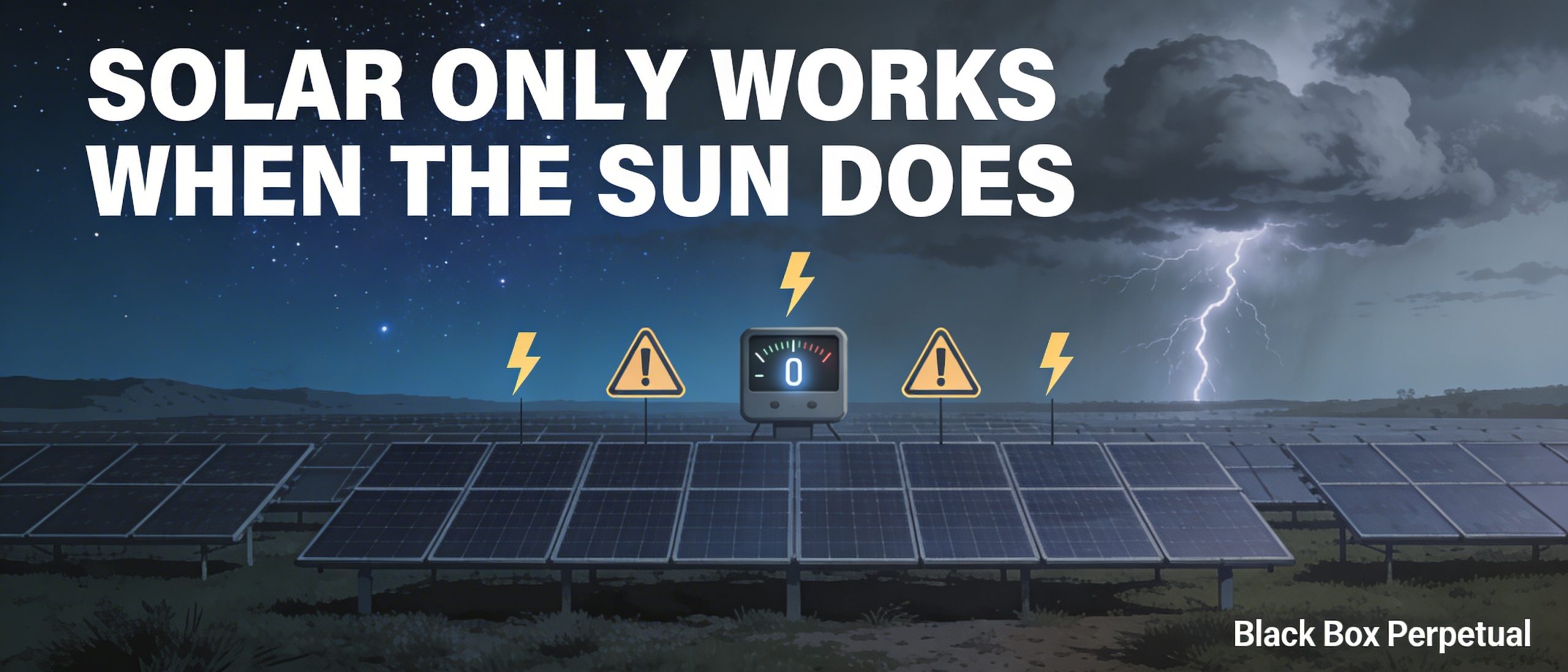
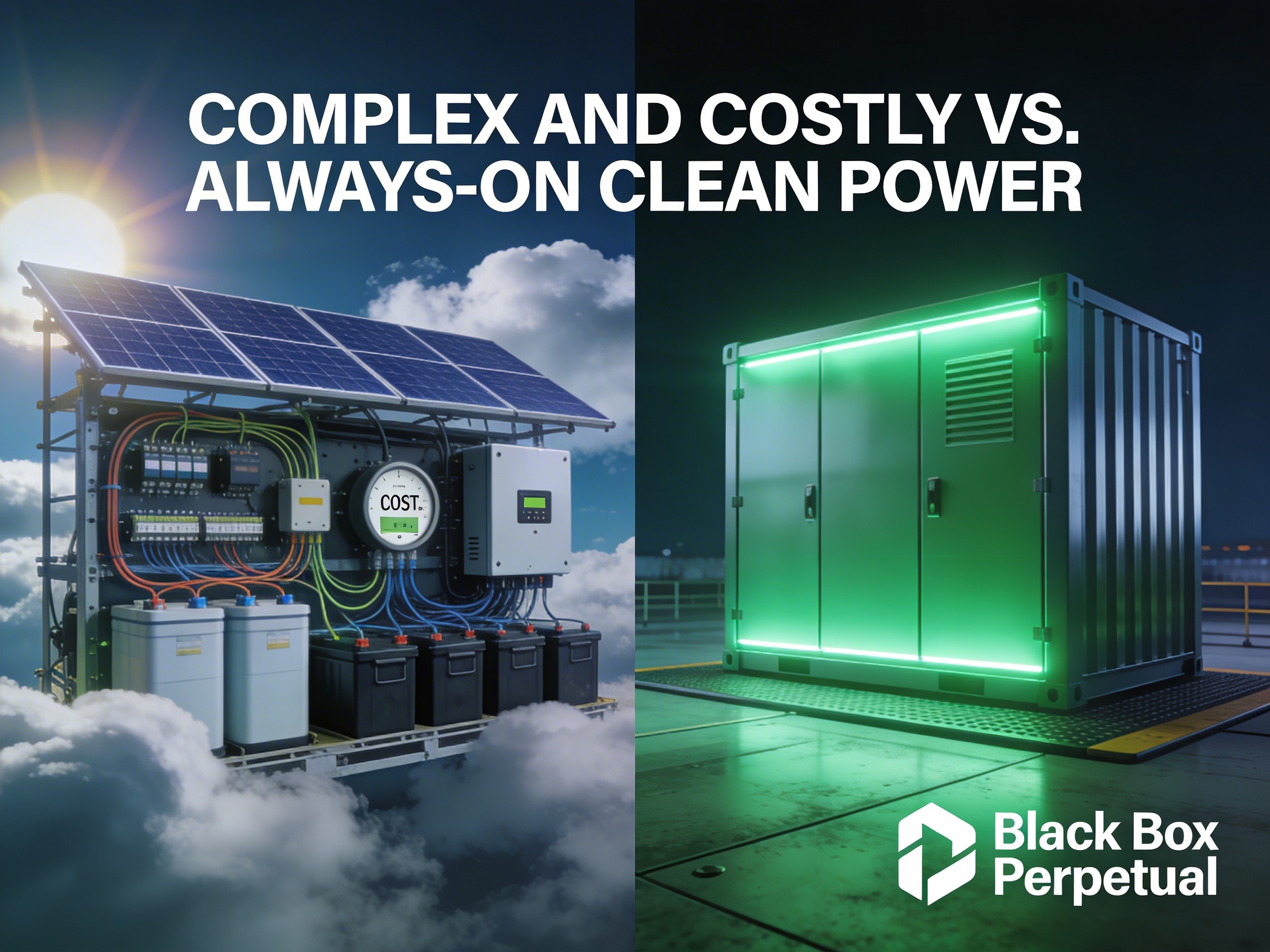
No amount of financial engineering changes the fundamental physics of solar: solar panels generate nothing at night and substantially less on cloudy days or in winter. Solar output follows a strict diurnal cycle — rising in the morning, peaking at midday, falling to zero at night. Light clouds may lower solar production by about 24%, while thick cloud layers can reduce it by as much as 67%. Seasonal variation compounds the problem: winter months in northern states deliver a fraction of the solar radiation of summer months.
For grid operators, this intermittency creates real challenges. As solar penetration increases, grid operators must ramp other generation sources up and down rapidly to maintain balance whenever solar output drops suddenly. The North American Electric Reliability Corporation (NERC) has specifically warned of unexpected inverter-tripping from solar generation, which could become a major threat as more solar is interconnected — with 500 gigawatts of solar expected to come online in the next decade.
When backup costs are factored in — the costs of maintaining dispatchable generation capacity that solar cannot replace — the picture changes. An analysis including federal subsidies and backup costs estimates the total cost of solar at $91.78 per MWh, compared to $62.90 for natural gas combined-cycle, once the full system cost is considered. These backup costs are not paid by solar installations — they are spread across the entire grid as increased charges to all consumers.
Must See Also: Can Renewable Energy Be Both Clean and Reliable? — Earth.org
Manufacturing’s Carbon Debt and the Coming Waste Crisis

Solar is lauded as clean energy — and over a full lifecycle, it genuinely is. Lifecycle emissions for solar photovoltaic panels average approximately 20–50 grams of CO₂-equivalent per kWh, compared to 486 gCO₂e/kWh for natural gas and 1,001 gCO₂e/kWh for coal. Most panels achieve full carbon payback within 1–3 years of operation. That is genuinely impressive.
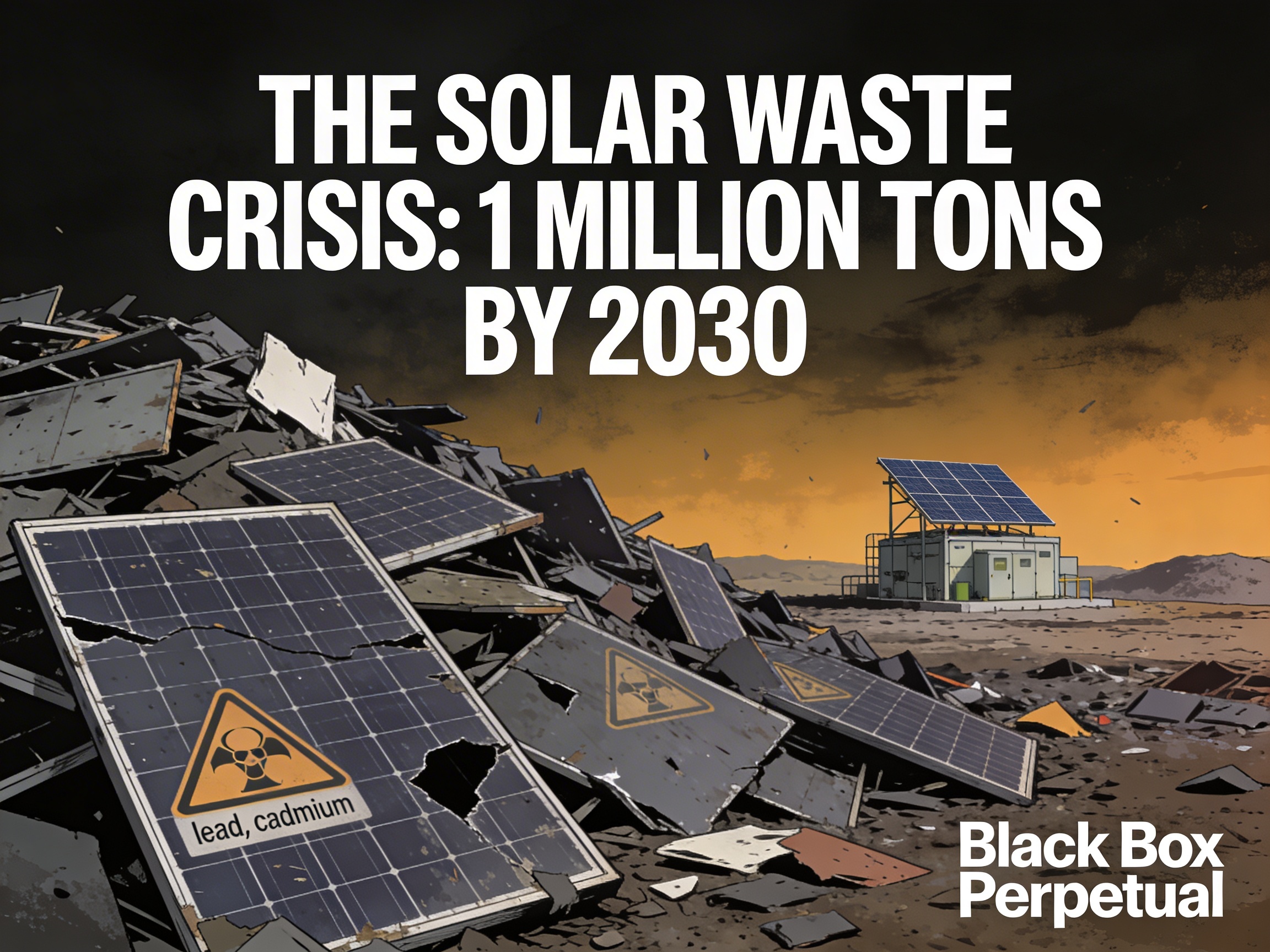
However, solar’s environmental story has a growing dark chapter: end-of-life panel disposal. By 2030, the United States is expected to generate as much as one million total tons of solar panel waste, rising to 10 million tons by 2050. Many solar photovoltaic modules contain toxic heavy metals including lead, cadmium, and antimony, which can contaminate soil and groundwater if panels are not carefully decommissioned and recycled. Some governments have already classified certain solar panels as hazardous waste.
The landfill disposal cost is approximately $2–$5 per panel, rising to around $5 for hazardous waste classification — while responsible recycling companies charge $18 per panel. Compounding this issue is a startling finding from industry: while the general assumption is that panels last 25–30 years, internal data from recyclers suggests actual panel lifespans may be closer to 11 years — driven by technology upgrades, storm damage, and construction breakage — meaning panels are entering the waste stream far faster than anticipated. The disposal cost liability is real, growing, and largely unaddressed in most solar ROI calculations.
Must See Also: As Millions of Solar Panels Age Out, Recyclers Hope to Cash In — Yale Environment 360
Who Pays the Most? Large Commercial and Industrial Energy Users
For residential consumers with modest power needs, south-facing rooftops, and sunny climates, solar with battery storage remains an economically sound long-term decision in many states — even without the federal tax credit. Homeowners paying above $0.20/kWh are still likely to see positive ROI over 10–13 years.
But the calculus is fundamentally different for large commercial and industrial (C&I) energy users. A large manufacturer, data center, or logistics facility consuming multi-megawatts of power continuously cannot simply install a rooftop array and call it energy independence. The gap between peak solar output hours and round-the-clock power demand is enormous, and the battery storage required to bridge that gap at scale becomes prohibitively expensive. Utility-scale solar with co-located energy storage ranges from $0.05 to $0.131 per kWh in levelized cost — but those figures assume favorable solar resources and do not account for extended cloudy periods, seasonal variation, or the premium cost of grid backup services that these facilities still require.
For any enterprise where power reliability is mission-critical, the intermittency problem is not an inconvenience — it is an existential operational risk. And as residential electricity rates continue to climb toward and beyond $0.20/kWh in many markets, the urgency of finding a truly reliable, cost-stable, always-on clean energy source intensifies.
Must See Also: Solar Cost of Electricity Beats Lowest-Cost Fossil Fuel Even Without Tax Credits — PV Magazine USA
A Different Approach: Black Box Perpetual

Understanding the full solar energy cost — not just the LCOE of panels in ideal conditions, but the complete system cost including storage, soft costs, hidden maintenance, backup power, waste disposal liability, and the newly eliminated federal tax credit — reveals a significant gap between what solar promises and what it actually delivers for power-critical applications.
Black Box Perpetual (BBP) was engineered specifically to address this gap. Rather than weather-dependent generation requiring expensive storage and backup capacity, the BBP system delivers continuous, clean energy output — 24 hours a day, 7 days a week, regardless of weather, season, or time of day. The system is containerized in a standard 20-foot shipping container as a 1MW unit, with scalability from that modular baseline to multi-gigawatt deployments.
The economics are structured to remove risk from the entry decision. Selected pilot program partners receive the BBP system and install it at their site, using the generated power freely for six months. There is no upfront capital outlay during the trial period — no $28,000 installation cost, no $10,000–$18,000 battery storage add-on, no soft costs, no permit fees, no insurance upgrades. After the trial, partners can return the unit or enter into a 25-year power purchase agreement for a 10MW+ system at greatly reduced pricing compared to current energy costs. Full-rate production deliveries are scheduled to begin June 2027, with the earliest contract effective date of May 1, 2027.
For C&I energy users navigating the true cost of solar — and finding it more complex, more conditional, and more expensive than the brochures suggest — BBP’s model of always-on, clean, contract-priced power represents exactly the kind of energy certainty that solar alone cannot provide.
Must See Also: Black Box Perpetual — Primary Power You Never Lose
The Full Cost Picture
Solar energy is not a scam — it is a genuine and important part of the global energy transition. But the “solar is now the cheapest electricity ever produced” narrative, while rooted in real LCOE data, leaves out too much. The full solar energy cost for a typical homeowner or business includes:
-
Installation: $12,000–$35,000+ before incentives
-
Battery storage: $9,000–$23,000 for true energy independence
-
Soft costs: ~65% of total system cost (marketing, labor, permits, overhead)
-
Hidden costs: Roof repairs, electrical upgrades, inverter replacement, insurance increases
-
Federal tax credit: Expired December 31, 2025 for residential customer-owned systems
-
Backup power costs: Grid-wide intermittency integration costs spread to all consumers
-
End-of-life disposal: $5–$18 per panel, with 1 million tons of U.S. waste by 2030
When all of these factors are accounted for, solar remains a valuable tool — but it is no longer the uncomplicated, always-affordable, always-on solution it is sometimes marketed as. For large enterprises, mission-critical facilities, and anyone who needs power the moment they need it, the question is not whether solar has a role in the energy mix — it clearly does — but whether solar alone, or even solar plus storage, can provide the reliability and cost stability that modern operations demand.