
The Short Answer Is: A Staggering Amount
Think about the last time you typed a question into an AI chatbot. It felt effortless — a few words in, an answer out. What you didn’t see was the enormous energy machine powering that simple exchange. Behind every AI response is a data center drawing electricity at a scale that would have seemed impossible a decade ago. And the numbers, when you actually look at them, are genuinely shocking.
A typical AI-focused data center consumes as much electricity as 100,000 households every single year. The largest ones now being constructed? They are expected to consume twenty times that amount. To put that in perspective: a single facility under development could match the annual electricity appetite of two million American homes.
Must See Also: AI: Five charts that put data-centre energy use – and emissions into context
What We’re Powering — And Why It Costs So Much
To understand why AI data centers consume so much power, you first need to understand what’s inside them. Traditional servers use standard CPUs that draw roughly 300–500 watts each. AI-optimized servers, by contrast, run dense clusters of GPUs — and a single advanced AI GPU can consume between 700 and 1,200 watts per chip, compared to 150–200 watts for a conventional processor. When you pack dozens of those into a rack, then fill a warehouse-sized building with thousands of racks, the math becomes alarming fast.
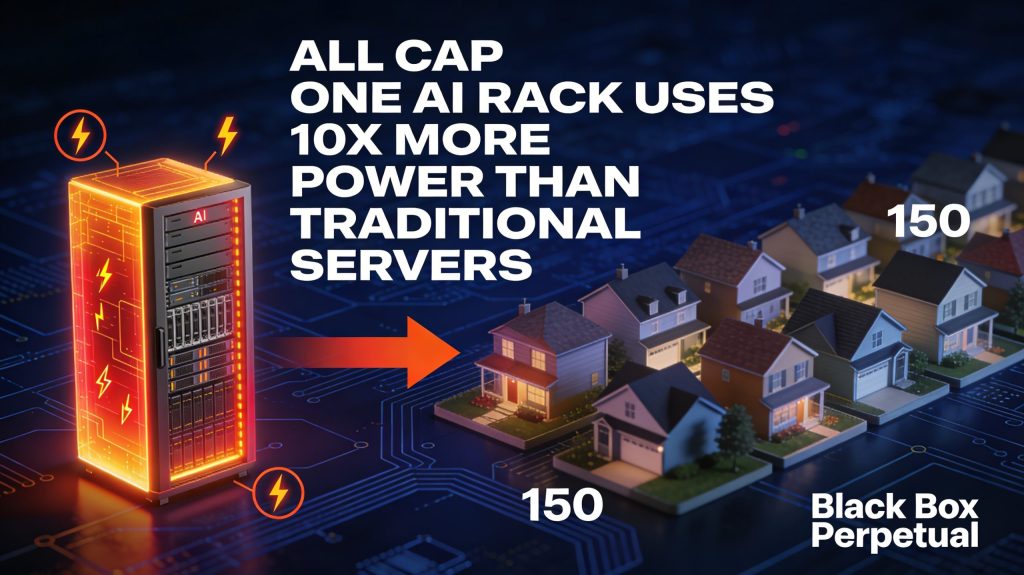
A traditional server rack pulls around 5–15 kilowatts. An AI-optimized rack requires 50 to 150 kilowatts — roughly 10 times more power in the same physical footprint. Some cutting-edge AI training facilities are already pushing individual racks past 100 kilowatts, fundamentally rewriting the rules of data center engineering.
That power density doesn’t just cost electricity to run the computers — it generates enormous heat, which must be continuously cooled. Cooling systems in less-efficient facilities can consume over 30% of total facility power, on top of everything the servers themselves draw.
Must See Also: What Are the Power Requirements for AI Data Centers?
The Electricity Numbers Are Almost Hard to Believe
In 2024, U.S. data centers consumed 183 terawatt-hours (TWh) of electricity — more than 4% of the entire country’s total electricity use, an amount roughly equivalent to the annual energy demand of all of Pakistan. Globally, data centers drew about 415 TWh in 2024, approximately 1.5% of all electricity produced on Earth.
And these numbers are accelerating, not stabilizing. The International Energy Agency projects that global data center electricity consumption will nearly double by 2030, reaching approximately 945 TWh — close to 3% of total global electricity consumption. In the United States specifically, data center power demand is projected to grow by 133% by 2030, reaching 426 TWh. Some scenarios from the Lawrence Berkeley National Laboratory put the 2028 U.S. figure as high as 580 TWh, or up to 12% of the nation’s total electricity use.
Already, certain states feel the strain acutely. In 2023, data centers consumed about 26% of all electricity in Virginia — over one in every four kilowatt-hours generated in the entire state.
Must See Also: US data centers’ energy use amid the artificial intelligence boom

Training a Single AI Model Can Cost Tens of Millions in Electricity Alone
If those national and global statistics feel abstract, zoom in on a single AI model. Training OpenAI’s GPT-4 reportedly consumed approximately 50 gigawatt-hours of electricity — enough to power the entire city of San Francisco for three days — at an estimated electricity cost exceeding $100 million. Training GPT-3, its predecessor, used an estimated 1,287 megawatt-hours and produced roughly 552 tons of CO₂.
Every time you send a ChatGPT query, it consumes roughly 2.9 watt-hours of electricity. That sounds small until you learn that ChatGPT alone processes over 2.5 billion queries every day. That adds up to approximately 850 megawatt-hours of daily electricity consumption — enough to power around 29,000 U.S. homes for an entire year, just from one AI chatbot’s daily output.
For context, a traditional Google search uses roughly 0.3 watt-hours. A single ChatGPT query uses ten times as much. AI video generation uses 100 times more energy than generating text. The computing power required for AI training has been doubling approximately every 100 days, far outpacing any gains in efficiency.
Must See Also: AI has high data center energy costs — but there are solutions
The Financial Costs Are Equally Staggering
Building an AI data center is not merely an electricity problem — it is also one of the most capital-intensive construction projects in the modern economy. IBM’s CEO recently stated that a fully equipped 1-gigawatt AI data center costs approximately $80 billion to build and equip. A breakdown of that spending includes:
-
GPUs and accelerators: $35–45 billion (50–60% of total)
-
Power delivery infrastructure: $10–15 billion
-
Liquid cooling systems: $6–10 billion
-
Building, networking, and land: $7–12 billion
Operating costs are brutal as well. A single 1 GW campus consumes 8–9 TWh of electricity per year, translating to $800 million to $1.2 billion in annual electricity bills alone at typical U.S. industrial rates. Total annual operating costs including staff, maintenance, water, and depreciation run $3–4.5 billion per year.
Globally, an estimated $580 billion was spent on AI-focused data center infrastructure in 2025 alone. Nvidia has projected that $1 trillion will ultimately be spent on data center upgrades for AI, with most investment flowing from hyperscale providers like Amazon, Microsoft, Google, and Meta.
Must See Also: The Real Cost of Running AI: A Datacenter Economics Breakdown
The Grid Is Already Showing Cracks
This explosion in energy demand is not occurring in a vacuum — it is placing severe stress on electrical infrastructure built for a different era. Federal Energy Regulatory Commission panelists warned in 2025 that the large-scale energy consumption of AI data centers “presents challenges to supply and demand and to technical engineering requirements,” with a rising number of small-scale outages and “near misses” already being recorded.
In one real incident, data centers in the PJM grid region suddenly disconnected from the utility grid, triggering “a huge surge in excess electricity” that forced grid operators to rapidly cut back power plants to “avoid a worst-case scenario of cascading power outages across the region”. Alison Silverstein, a former senior adviser to the chairman of the Federal Energy Regulatory Commission, warned: “What this event tells us is that the behavior of data centers has the potential to cause cascading power outages for an entire region.”
With 79% of industry leaders expecting AI power demand to grow sharply through 2035, the risk of widespread grid instability is not a fringe scenario — it is a mainstream concern. Google, Amazon, and Microsoft are currently in intense negotiations with utility leaders about how to satisfy their energy requirements without triggering blackouts during peak demand.
Must See Also: AI Data Center Buildout Boosts Blackout, Disruption Risk
Renewables Alone Cannot Keep Up
Many Big Tech companies have pledged carbon neutrality or 100% renewable energy procurement, and genuine progress has been made. However, the fundamental challenge with AI data centers is that they require continuous, 24/7 power — not intermittent energy that depends on sunshine or wind speed. Solar panels don’t generate electricity at night. Wind doesn’t blow on demand during heat waves. Battery storage, while advancing, is not yet scalable enough to smooth out the enormous fluctuations between daytime generation and nighttime AI demand.
California’s infamous “Duck Curve” — a sharp mismatch between midday solar generation and evening demand surges — demonstrated exactly this vulnerability when the state faced rolling blackouts during a 2020 heatwave. These problems only get harder as AI data center demand intensifies. Nuclear power offers consistent, 24/7 clean output, but building a plant takes decades — far too slow to address the immediate power gap. That’s why Microsoft signed a 20-year deal to restart a unit at the Three Mile Island nuclear plant, Google committed to small modular reactors, and Amazon purchased a nuclear-powered data campus from Talen Energy. These moves speak volumes: even the world’s richest companies can’t simply plug their AI ambitions into an existing grid and call it solved.
Must See Also: Gridlocked: How AI is Overwhelming The World’s Power Systems
Could a Self-Contained, Continuous Power System Be the Answer?
Given the scale of this crisis — spiraling costs, grid instability, intermittent renewables, and decade-long nuclear timelines — the question becomes increasingly urgent: Is there a fundamentally different way to power an AI data center?
That is precisely the question being explored by Black Box Perpetual (BBP), a company currently evaluating partners for a pilot program centered on a power generation system designed to deliver continuous, clean energy with no grid dependency. The system is containerized in a standard 20-foot shipping unit, producing 1 megawatt of power — and it is engineered to scale from that single unit to multi-gigawatt deployment.
The economics BBP describes are striking: selected pilot partners receive and install the system, then use the generated power freely for six months. After that trial period, partners may either return the unit or enter into a 25-year power purchase agreement for a 10 MW+ system, structured to deliver significantly reduced pricing compared to current energy costs. For organizations facing $800 million to $1.2 billion annual electricity bills — or worse, an inability to secure grid power at any price — an off-grid, continuously generating, containerized power solution represents exactly the kind of paradigm shift the AI infrastructure industry needs.
BBP is currently qualifying potential customers, developing delivery requirements, and targeting full-rate production beginning approximately June 2027. For data center operators, hyperscalers, enterprise AI teams, or any organization staring down an electricity supply problem with no good grid-based answer, the Project Initiation Form at blackboxperpetual.com is a logical first step.
Must See Also: Black Box Perpetual – 50% Reduced Cost – 24/7 Power
What Comes Next
The IEA’s own projections suggest that without significant intervention, AI data centers could consume up to 21% of overall global energy demand by 2030 when the full cost of delivering AI to consumers is factored in. That is not a typo: from 1.5% of global electricity today to potentially one in five units of electricity generated on Earth, in just a few years.
AI-specific servers currently represent between 5–15% of data center power use, but the IEA projects that share will rise to 35–50% by 2030 as generative AI permeates every corner of the economy. The computing power required to run these systems is doubling every hundred days — and each doubling means another wave of GPU clusters, another round of billion-dollar facility builds, and another enormous demand signal sent to a power grid already struggling to keep up.
The electricity problem of AI is not a future concern to be studied in committee. It is happening right now, in real time, in the states where data centers are concentrated, in the utility boardrooms trying to plan capacity additions fast enough, and on the power bills of ordinary Americans who share the grid with the AI industry. The numbers may have shocked you. The next question is: what are we going to do about them?
Must See Also: America’s AI industry faces big energy and environmental risks