
The advertised economics of coal-fired power plants obscure a staggering web of hidden costs — including billions in annual health damages, rising per-megawatt-hour expenses, decommissioning liabilities that dwarf initial projections, and externalized climate damage — making clean, continuous alternatives like the Black Box Perpetual system a rational and urgently needed departure from fossil-fuel dependency.
Coal’s Price Tag Is Far Larger Than the Sticker Says
Every time a coal-fired power plant generates electricity, it generates something else too: a long list of costs that never appear on an energy bill. These hidden costs — measured in health damage, environmental contamination, climate liability, and escalating operational expenses — are real, quantifiable, and enormous. They are simply shifted off the utility’s balance sheet and onto communities, healthcare systems, governments, and future generations.
For decades, coal has been positioned as the baseline of “affordable” electricity. But a growing body of research from institutions including the National Research Council, the Rocky Mountain Institute, and Energy Innovation reveals a picture that is fundamentally different. The true, fully loaded cost of coal power is far higher than what utilities report — and it is rising faster than inflation every year. Understanding those hidden costs is not just an academic exercise; it is essential context for any enterprise or policymaker evaluating energy strategy.
Must See Also: The Hidden Costs of Coal Power Plants That Utilities Don’t Want You to Know
The Sticker Price Is Already Getting Worse
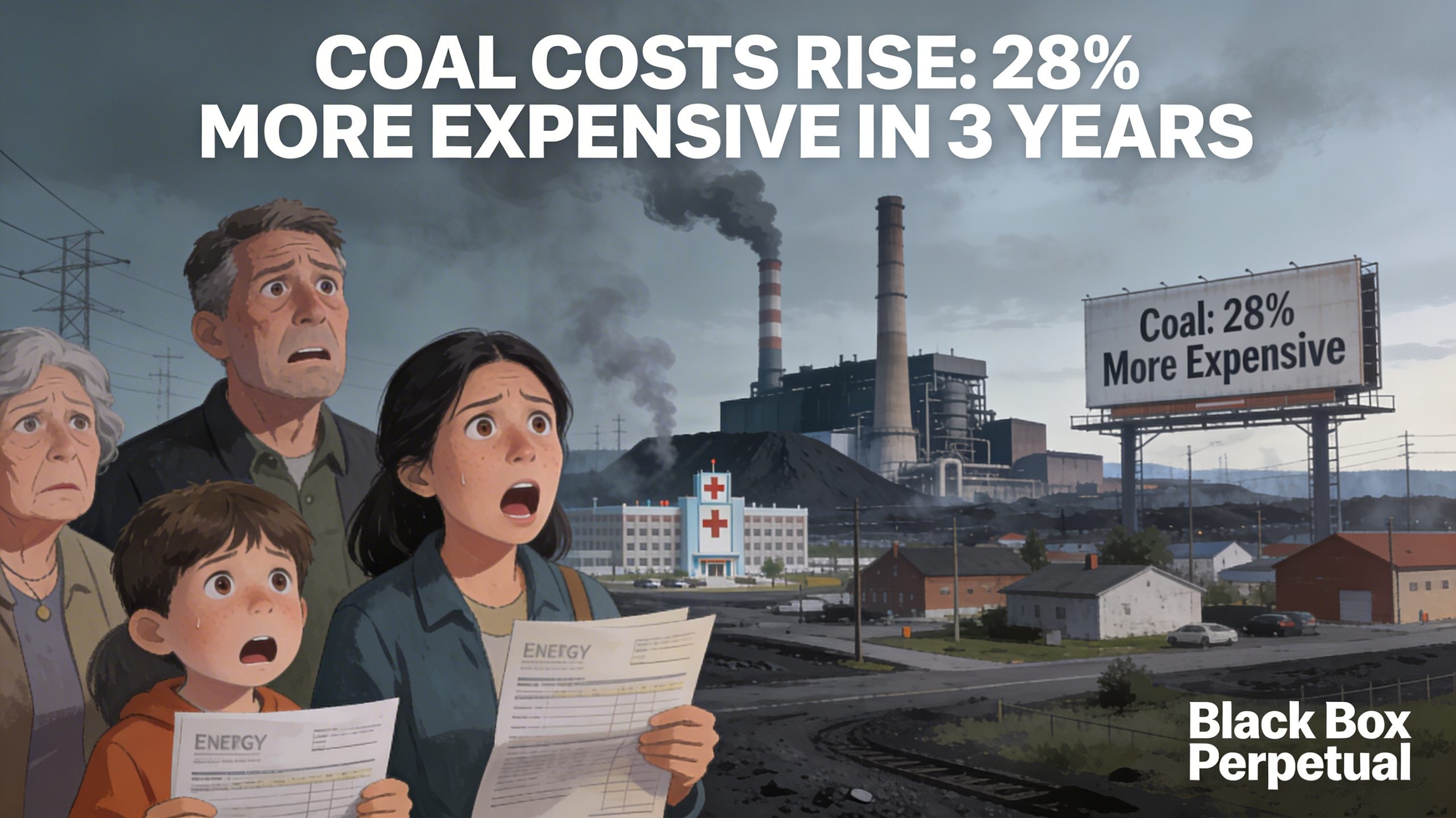
Start with the costs utilities do acknowledge — and even those are moving in the wrong direction for coal. A comprehensive 2025 analysis by Energy Innovation found that coal power was 28% more expensive in 2024 than it was in 2021, with the weighted average cost rising from $36 per megawatt-hour to $46 per MWh over that three-year period. That increase ran significantly faster than inflation, which rose approximately 16% during the same window.
The numbers at the plant level are even more striking. Coal plant owners collectively spent $6.2 billion more in 2024 than they would have spent generating the same amount of electricity via coal in 2021 — and every dollar of that excess cost was passed directly to consumers. According to the same analysis, 95% of the 162 coal-fired plants still operating at the start of 2025 were more expensive in 2024 than they were in 2021, and 76% saw costs grow faster than the rate of inflation. Half of those plants saw cost increases at double the inflation rate.
Part of the reason costs are climbing is that coal plants are being utilized less — average capacity factors dropped from 46% in 2021 to 38% in 2024 — which means fixed costs are spread over fewer megawatt-hours, pushing the per-unit price higher even when fuel costs are flat. Aging infrastructure requiring capital reinvestment is accelerating the deterioration further.
Must See Also: The Hidden Costs of Coal Power Plants That Utilities Don’t Want You to Know
The Health Cost Nobody Puts on Your Bill
The most staggering hidden cost of coal is the one most deliberately kept out of public view: the damage coal combustion inflicts on human health. A landmark study by the National Research Council, mandated by Congress, found that coal-fired power plants impose approximately $63 billion per year in health damages in the United States alone — costs driven primarily by air pollution causing premature deaths, respiratory illness, cardiovascular disease, and neurological harm.
These costs are called “hidden” because they are not factored into the market price of coal or the electricity it generates. If coal’s health damages were included in retail electricity prices, consumers would face bills approximately 25% higher than what they pay today. In other words, coal power is only “cheap” because society — not the utility — absorbs the health bill.
The Rocky Mountain Institute’s 2025 analysis of coal plants that continue to run when cheaper energy resources are available found that these “uneconomically dispatched” plants cost communities $13 to $26 billion in health costs every year. From 2015 through 2023, the cumulative added health burden from this practice totaled $236 billion — an extraordinary transfer of wealth from ordinary citizens to utility shareholders. According to research, air pollution particles from coal-fired power plants are more than twice as harmful to human health as particles from other sources.
Must See Also: The Hidden Costs of Coal Power Plants That Utilities Don’t Want You to Know

The Human Toll Behind the Statistics
Abstract billions can obscure very real human suffering. The RMI analysis put concrete faces on the health crisis by quantifying specific health outcomes attributable to uneconomically dispatched coal emissions. These included 3.4 million instances of increased albuterol use and more than 1.8 million cases of persistent cough across affected communities. Most striking was the finding that these emissions created over 50,000 new cases of asthma in people who did not previously have asthma at all.
The economic ripple effects extend well beyond medical costs. Coal plant emissions from uneconomic dispatch have been estimated to cause over 900,000 lost workdays and more than 3 billion lost school days nationwide, as adults and children required time to recover from respiratory and cardiovascular episodes. For communities located near coal plants — often lower-income and communities of color — this represents a compounding inequality that the sticker price of coal electricity completely erases.
The broader public health literature is equally damning. Coal’s combustion byproducts — including mercury, lead, soot, arsenic, and other heavy metals — pollute air and contaminate groundwater, contributing to asthma, cancer, heart and lung disease, neurological problems, and developmental harm in children. These are not edge cases or worst-case scenarios; they are documented, recurring outcomes from the routine operation of coal-fired power plants.
Must See Also: The Hidden Costs of Coal Power Plants That Utilities Don’t Want You to Know

The Decommissioning Debt Nobody Is Saving For
When a coal plant eventually closes — whether from market economics, regulation, or physical deterioration — it leaves behind a contaminated site that can cost more to clean up than anyone anticipated. Decommissioning a coal power plant is a multi-phase process involving hazardous equipment removal, coal ash remediation, groundwater testing, demolition, and often years of ongoing environmental monitoring.
Studies of historical coal plant decommissioning projects in the United States estimate the mean decommissioning cost at $117,000 per megawatt of installed capacity — a figure that can translate to hundreds of millions of dollars for a large plant. World Bank research places the range of decommissioning costs at $58,000 to $117,000 per megawatt, with significant variation based on plant size, contamination levels, and local regulatory requirements.
The core problem is that most utilities’ financial reserves — called asset retirement obligations (AROs) — are woefully inadequate to cover actual decommissioning and environmental cleanup costs. This gap is a ticking financial liability that falls on ratepayers, taxpayers, and, in the case of utility bankruptcy, the communities left holding the remediation bill. The reason many shuttered coal plants sit structurally intact for years after retirement is precisely because the costs of cleaning up accumulated toxic coal ash and waste are so daunting that developers refuse to accept the risk.
Must See Also: The Hidden Costs of Coal Power Plants That Utilities Don’t Want You to Know
Political Pressure Is Making the Problem Worse
Rather than allowing coal’s market-driven decline to proceed, recent political interventions have begun actively forcing uneconomic plants to remain online — directly increasing consumer costs. Energy Innovation’s 2025 analysis noted that executive orders from the Trump administration mandate that utilities maintain coal plants in operation even when doing so raises consumer costs or when plant closures had already been planned. As a specific example, a coal plant in Michigan was compelled to stay operational despite the utility’s own calculation that closing it would save customers more than $600 million.
The Trump administration’s stated goal of cutting household energy bills in half by mid-2026 stands in direct contradiction to its pro-coal policies. The escalating costs of coal are likely to have precisely the opposite effect on American consumers, according to energy analysts. When 99% of the coal fleet is already more expensive to operate than replacement by local wind, solar, and battery storage — a finding from Energy Innovation’s own cost analysis — mandating the continuation of coal operations is, by definition, a mandate for higher electricity costs.
Must See Also: The Hidden Costs of Coal Power Plants That Utilities Don’t Want You to Know
The Solution the Industry Doesn’t Want to Discuss
Every hidden cost of coal — health damage, climate liability, decommissioning debt, escalating operational expense — has one thing in common: it flows from a century-old model of burning a finite, toxic fuel to boil water and spin a turbine. Escaping that model entirely is what makes genuinely new approaches to power generation so consequential.
Black Box Perpetual (BBP) represents exactly this kind of departure. BBP’s system delivers continuous, clean energy in a containerized 1MW unit, with no combustion, no fuel procurement, no coal ash, and no embedded health liabilities for surrounding communities. There is no decommissioning toxic waste problem, no exposure to the volatile coal fuel markets that sent plant costs rising 28% in three years, and no participation in the $13 to $26 billion annual health damage economy that coal power quietly sustains.
For large enterprises evaluating their energy future, BBP is currently evaluating partners for a pilot program in which selected organizations receive the system at their site and use the generated power free for six months. After the trial period, enterprises may enter a 25-year power purchase agreement for a 10MW or larger system at greatly reduced pricing compared to current energy costs. Full-rate production and first deliveries are scheduled for June 2027.
Must See Also: The Hidden Costs of Coal Power Plants That Utilities Don’t Want You to Know
The Full Accounting
Coal power is not cheap. It never was. It is cheap only in the narrow accounting frame that utilities and coal companies have successfully imposed on public discourse for generations — a frame that deliberately excludes $63 billion in annual health damages, $236 billion in accumulated community health costs over less than a decade, hundreds of millions per plant in decommissioning liabilities, and the staggering long-term cost of carbon emissions that will compound for centuries. When those costs are included, coal is among the most expensive forms of energy on Earth — and it is getting more expensive every year. The only question is who pays, and when.